
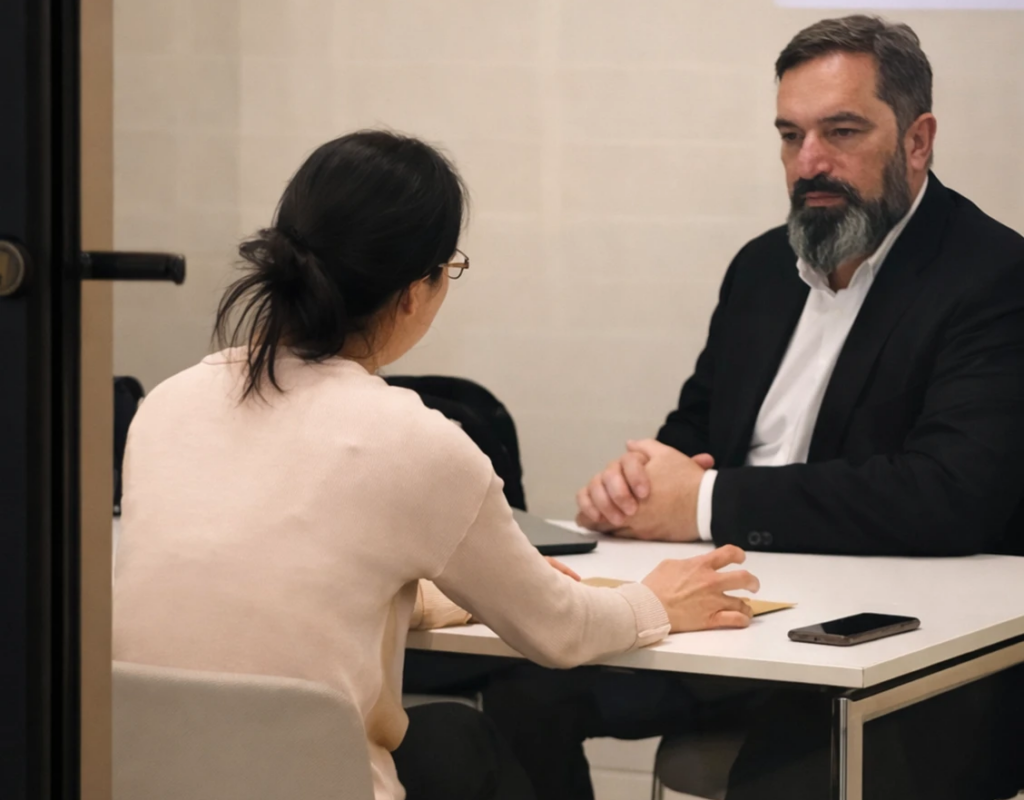
Scott Keeley is a registered patent agent. Here, he works with an inventor during office hours at the Free Library of Philadelphia.
What’s the difference between a patent agent and a patent attorney?
Patent agents are registered patent practitioners, licensed by the US Patent and Trademark Office, to prosecute patents before the USPTO. They have passed the patent bar, a rigorous national exam – the same bar that patent attorneys must pass. Like patent agents, they must meet this requirement to be recognized by the USPTO.
Patent attorneys are also recognized patent practitioners who are licensed by the USPTO. They can do everything a patent agent does, plus give legal advice, and represent their clients in court. Some of them are litigating attorneys; they’re the ones who argue infringement and other cases. In addition, only patent attorneys can file trademarks on your behalf. Keep in mind, though, that anyone can file a trademark pro-se, i.e., on their own. The process is clear and accessible, and the USPTO provides lots of support, both online and by phone.
Agents v. Attorneys: What it Costs
Patent attorneys usually charge more than patent agents. We reviewed fees from three New England firms for preparing a provisional patent application (as of 2023):
Big Firm A: $5,145 – $7,688
Big Firm B: $3,800 – $4,300
Big Firm C: $3,400 – $5,400
A patent agent would charge $2,000 – $3,200 for the above.
Note: The above fees list only the filing of the provisional-application filing. They do not count the nonprovisional patent application, or the years-long work involved in pursuing and defending your patent application. See this blog post for a picture of the entire patent process and attendant fees.
Online “Experts”
Hundreds of “advisors, “guides” and “gurus,” are online, especially on youtube and social media, claiming to be patent experts. Before working with them, ask: Are you a registered patent practitioner?
If the answer is yes, ask for their registration number. You can look up a practitioner’s registration number here. (Scott’s is 74622). The USPTO assigns this number only to recognized patent practitioners. (Note: this is different from a “customer number,” which is granted to anyone who files more than one application on their own.)
If the answer is no, you are not working with a licensed patent practitioner. They may know a thing or two about patents, but they are not permitted to file a patent application on your behalf, nor give legal advice. Sometimes they charge as much as a patent practitioner does, to simply give advice.
Scott Keeley is a registered patent agent who prosecutes patents before the USPTO. In that official capacity, he can answer all your questions about the patent process. Scott also has 20 years of experience in manufacturing and licensing, gained from his own products and those of this clients. He has given workshops on patenting and licensing since 2016.
Keeley DeAngelo are not lawyers; we don’t give legal advice.